
Cognitive Distortions: 12 Thinking Traps With Everyday Examples
A cognitive distortion is a habitual error in how we interpret events: the conclusion feels obvious, but it does not follow from the facts. The term comes from Aaron Beck's cognitive therapy. Everyone has them. They are worth learning to spot because they amplify anxiety, shame and low mood.
Where the list comes from
In 1963 Beck described how the thinking of his depressed patients departed from the facts in consistent ways: they magnified failures, generalised from single events and took neutral events personally. His student David Burns later made these errors widely known in the book Feeling Good (1980). There is no single official list; depending on the author there are between 10 and 15. These are 12 of the most common.
The 12 distortions, with an example and a testing question
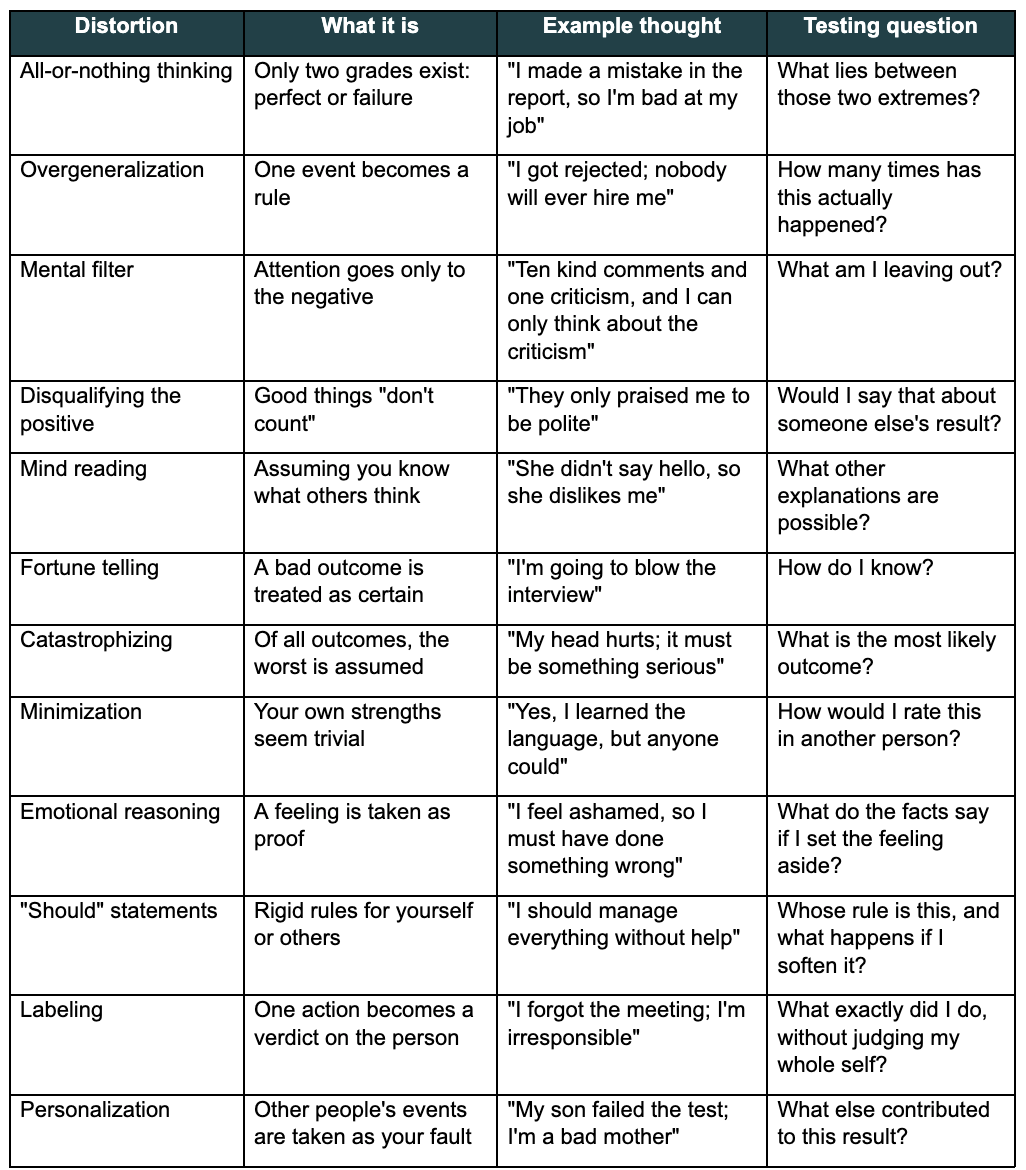
How to notice a distortion in the moment
The thought itself is hard to catch, but it leaves traces:
The easiest place to catch distortions is on paper. Write the thought down word for word in a thought record, then compare it with the list.
- A sudden shift in mood. You were fine and now shame or anxiety is at 7 out of 10. Ask: "What just went through my mind?"
- Giveaway words. "Always", "never", "everyone", "nobody", "should", "definitely", "terrible".
- The thought sounds like a verdict. Not "I was late" but "I can't be relied on".
The easiest place to catch distortions is on paper. Write the thought down word for word in a thought record, then compare it with the list.
What to do next: three questions
- What are the facts for and against? Only things that can be checked.
- What would I say to a friend in this situation? We tend to be fairer to others than to ourselves.
- How could I say this more accurately? Not "nobody will ever hire me" but "one of the five companies I applied to said no".
The aim is not to swap a negative thought for a positive one. The aim is a thought that fits the facts.
Everyone has them: when they become a problem
Tired, hungry or stressed people think in more distorted ways, and that is normal. It is worth speaking to a professional if these thoughts take up much of the day, if they lead you to avoid work, people or everyday activities, if low mood or anxiety lasts more than two weeks, or if you start to think life is not worth living.
Frequently asked questions
How many cognitive distortions are there? There is no fixed number. Popular lists contain between 10 and 15, because authors group similar errors differently.
Is a cognitive distortion the same as a cognitive bias? No. Distortions are a concept from cognitive therapy: errors in thoughts about ourselves, other people and the future, linked to mood. Cognitive biases, such as anchoring, are studied in the psychology of judgment and decision-making and affect choices in general.
Can you get rid of them completely? No, and that is not the goal. You can learn to notice them sooner and to stop treating every thought as a fact.
In RIVA PSY the distortion list is built into the thought-challenging exercise: pick the one that fits and test the thought step by step. Your entries stay on your phone. [Store link or "Notify me at launch" form]
This article is educational and is not a substitute for therapy. If you need urgent help, see the crisis page.
Sources
Is a cognitive distortion the same as a cognitive bias? No. Distortions are a concept from cognitive therapy: errors in thoughts about ourselves, other people and the future, linked to mood. Cognitive biases, such as anchoring, are studied in the psychology of judgment and decision-making and affect choices in general.
Can you get rid of them completely? No, and that is not the goal. You can learn to notice them sooner and to stop treating every thought as a fact.
In RIVA PSY the distortion list is built into the thought-challenging exercise: pick the one that fits and test the thought step by step. Your entries stay on your phone. [Store link or "Notify me at launch" form]
This article is educational and is not a substitute for therapy. If you need urgent help, see the crisis page.
Sources
- Beck, A. T. (1963). Thinking and depression: I. Idiosyncratic content and cognitive distortions. Archives of General Psychiatry, 9, 324–333.
- Burns, D. D. (1980). Feeling Good: The New Mood Therapy.
- Beck, J. S. (2020). Cognitive Behavior Therapy: Basics and Beyond, 3rd ed. Guilford Press