Winter Blues vs Seasonal Depression: How to Tell the Difference
The winter blues are a mild, short-lived dip in mood and energy during the darker months that does not stop you from getting on with life. Seasonal affective disorder (SAD) is a form of depression: low mood or loss of interest is present nearly every day for at least two weeks, interferes with work and relationships, and returns at the same time each year.
Short answer: three differences
- Duration. Winter blues last days and lift on their own. In depression, symptoms persist for two weeks or more.
- Severity. With winter blues, good things still feel good. In depression, interest and pleasure fade for almost everything.
- Impact. With winter blues you still do what you need to, with less enthusiasm. In depression, work, home life and relationships clearly suffer.
What seasonal affective disorder is
SAD was first described by Norman Rosenthal and colleagues in 1984. It is now understood as depression with a seasonal pattern, not a separate illness. According to the US National Institute of Mental Health (NIMH), in winter-pattern SAD symptoms start in late fall or early winter, last about four to five months, and go away in spring; a diagnosis requires that episodes have occurred in specific seasons for at least two consecutive years.
Alongside the usual symptoms of depression, winter-pattern SAD often brings:
Alongside the usual symptoms of depression, winter-pattern SAD often brings:
- oversleeping;
- overeating, particularly a craving for carbohydrates, and weight gain;
- social withdrawal, sometimes described as feeling like "hibernating".
Comparison table
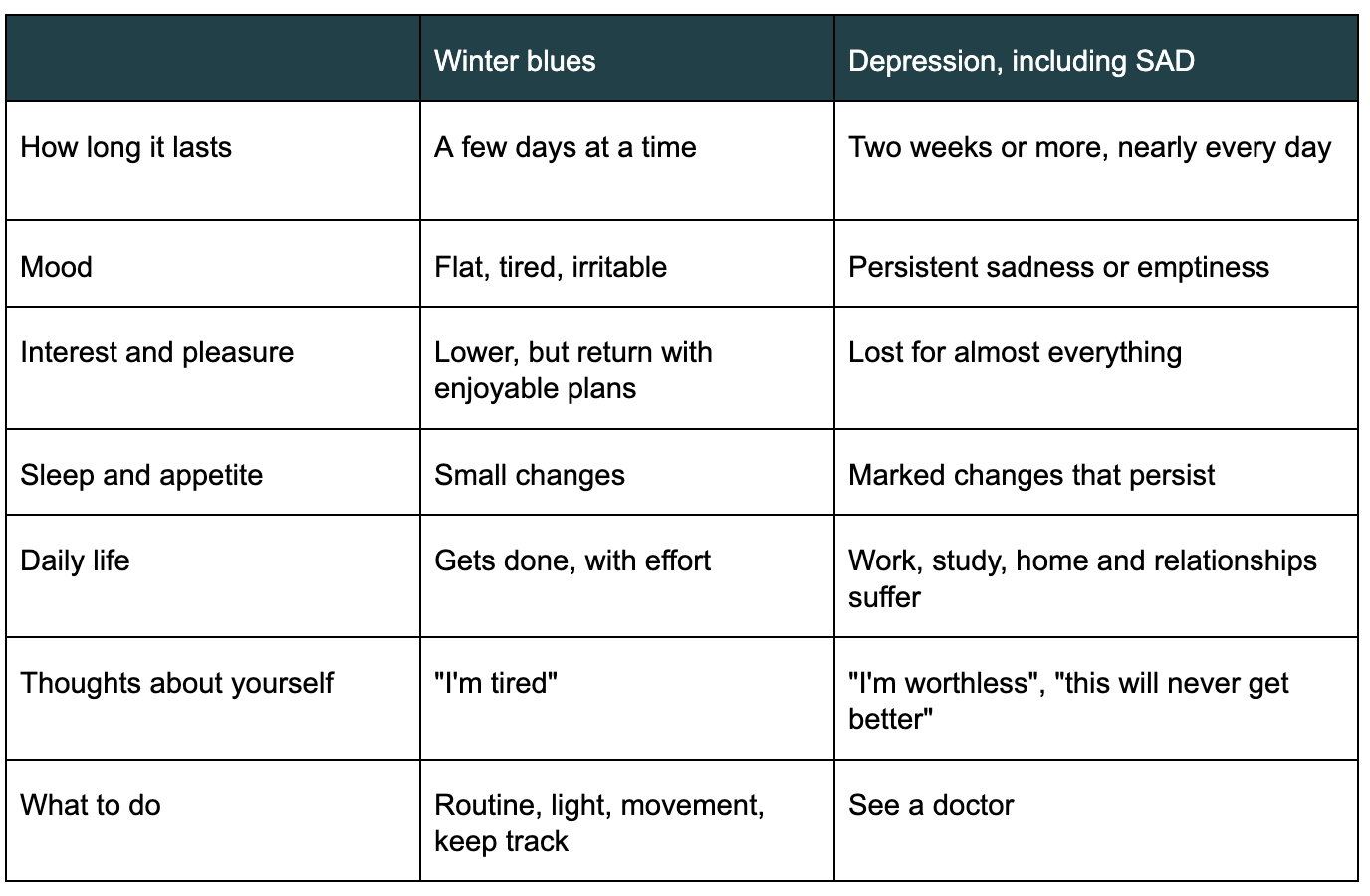
The table is a guide. Only a health professional can make a diagnosis.
When to see a doctor
Make an appointment if:
A GP or primary care doctor is the usual first step. They can assess how you are, rule out other causes of tiredness and refer you for therapy or to a psychiatrist.
If you are having thoughts of suicide or of harming yourself, do not wait for an appointment. In the US, call or text 988. In the UK and Ireland, call Samaritans on 116 123. Elsewhere, call your local emergency number or find a helpline on the crisis page.
- low mood or loss of interest has lasted more than two weeks;
- you are struggling to work, look after yourself or care for your family;
- your sleep or appetite has changed a lot;
- you are drinking more to cope;
- this pattern returns year after year.
A GP or primary care doctor is the usual first step. They can assess how you are, rule out other causes of tiredness and refer you for therapy or to a psychiatrist.
If you are having thoughts of suicide or of harming yourself, do not wait for an appointment. In the US, call or text 988. In the UK and Ireland, call Samaritans on 116 123. Elsewhere, call your local emergency number or find a helpline on the crisis page.
What helps: light, routine, activity
These steps are reasonable for winter blues and can sit alongside treatment for depression. They do not replace it.
Light therapy. Bright light therapy is one of the treatments for winter-pattern SAD. NIMH describes sitting in front of a 10,000-lux light box for about 30 to 45 minutes, usually first thing in the morning, from fall to spring. A Cochrane review found too little evidence to say whether light therapy prevents new episodes in people who have had SAD before. Talk to a doctor before buying a light box, especially if you have an eye condition, bipolar disorder, or take medication that increases sensitivity to light.
- Daylight. Get outside in the morning, even on overcast days, and sit near a window when you work.
- Sleep routine. Go to bed and get up at the same time, weekends included.
- Movement. Regular physical activity, ideally outdoors in daylight.
- Planned activity. Low mood makes you want to cancel. Put one enjoyable and one useful activity in the diary each day and do them because they are planned, not because you feel like it.
- Keep track. Note your mood, sleep and activity for two weeks. If things are not improving, you will have a record to take to your appointment.
Light therapy. Bright light therapy is one of the treatments for winter-pattern SAD. NIMH describes sitting in front of a 10,000-lux light box for about 30 to 45 minutes, usually first thing in the morning, from fall to spring. A Cochrane review found too little evidence to say whether light therapy prevents new episodes in people who have had SAD before. Talk to a doctor before buying a light box, especially if you have an eye condition, bipolar disorder, or take medication that increases sensitivity to light.
What this article can't do
It cannot diagnose you or rule a diagnosis out. Tiredness and low mood occur in many health conditions that a doctor needs to assess. Decisions about medication and therapy belong in an appointment.
Frequently asked questions
How long do winter blues last? Usually a few days at a time. If low mood is present nearly every day for more than two weeks, speak to a doctor.
Does light therapy work? It is used as a treatment for winter-pattern SAD. There is not enough evidence that it prevents new episodes. Whether it suits you is a question for a doctor.
Can you have seasonal depression in summer? Yes. NIMH describes a less common summer-pattern SAD, with symptoms in spring and summer.
With RIVA PSY you can track your mood for two weeks and bring the pattern to your appointment. Your entries stay on your phone. [Store link or "Notify me at launch" form]
This article is for information only and is not a substitute for medical advice.
Sources
Does light therapy work? It is used as a treatment for winter-pattern SAD. There is not enough evidence that it prevents new episodes. Whether it suits you is a question for a doctor.
Can you have seasonal depression in summer? Yes. NIMH describes a less common summer-pattern SAD, with symptoms in spring and summer.
With RIVA PSY you can track your mood for two weeks and bring the pattern to your appointment. Your entries stay on your phone. [Store link or "Notify me at launch" form]
This article is for information only and is not a substitute for medical advice.
Sources
- National Institute of Mental Health. Seasonal Affective Disorder. nimh.nih.gov
- NHS. Seasonal affective disorder (SAD): overview. nhs.uk
- Rosenthal, N. E. et al. (1984). Seasonal affective disorder. A description of the syndrome and preliminary findings with light therapy. Archives of General Psychiatry. PubMed
- Nussbaumer-Streit, B. et al. Light therapy for preventing seasonal affective disorder. Cochrane Database of Systematic Reviews
- NICE. Depression in adults: treatment and management (NG222). nice.org.uk