
He left me. How do I stop hoping and waiting?
He's gone. And you are still waiting for a message. You check whether he's been online. At night you type "how to get my ex back" into the search bar. You know it doesn't help, but you can't stop.
Nothing is wrong with you. Almost everyone who has been left does the same. This article helps you stop waiting, little by little. Not in one day, but step by step.
Why it's so hard to let go
This person was a habit: his voice, his messages, the weekend plans. When all of that vanishes overnight, it leaves a hole. You crave him in much the same way you'd crave sugar or cigarettes if they were suddenly taken away. It isn't weakness and it isn't foolishness. It's withdrawal, and it passes.
Why hope makes it hurt more
Hope feels like something to hold on to. In fact, it keeps the wound from closing. Every time you think "what if he texts?", you open the door again. And then it hurts again, because he didn't.
You don't need to kill hope by force. You only need to stop feeding it.
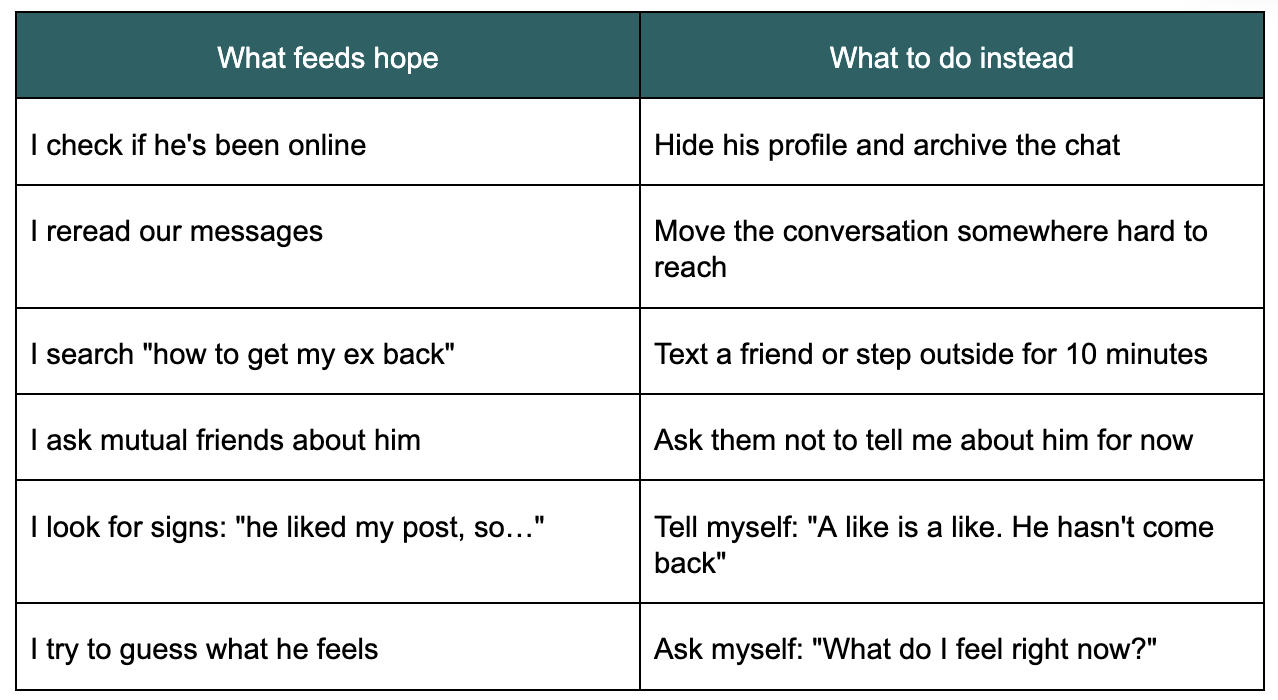
Why searching "how to get him back" doesn't help
When you read advice on getting him back, you feel better for a minute: it seems there's a plan. Then the anxiety returns and you search again. It's a loop.
One more thing. A lot of that advice teaches tricks: make him jealous, disappear, text "by accident". A relationship held together by tricks doesn't become warmer. Only someone who wants to come back comes back. And that isn't yours to decide.
What to do: five simple steps
Step 1. Say the fact out loud. Once a day, calmly: "He left. Right now we are not together." Not "forever", not "nobody will ever love me". Only what is true today. This helps your mind stop arguing with what happened.
Step 2. Put the reminders out of sight. You don't have to delete everything. Just move it: photos into a separate folder, the chat into the archive, his things into a box on top of the wardrobe. Mute his notifications. The less often you bump into him, the faster the craving fades.
Step 3. The 20-minute rule. Want to text him, check his profile or search again? Don't forbid it. Say: "I'll do it in 20 minutes, if I still want to." Set a timer and do something with your hands: wash the dishes, take a shower, go for a walk. An urge is like a wave: it rises, holds and drops. Most of the time, it's weaker after 20 minutes.
Step 4. Give sadness a time slot. Set aside 15 minutes a day to cry, be angry, or write him a letter you won't send. Use a timer. When sadness shows up at another time, tell it: "I'll see you at seven tonight." This keeps the pain from taking the whole day.
Step 5. Keep the basics going. Eat three times. Go to bed at the same time. Get outside for at least 10 minutes. Message one real person. For now, that's enough. Big changes can wait.
What if he comes back?
Sometimes people come back. Sometimes they don't. Nobody knows, and no article can tell you.
Here is what's clear: while you wait, your life is on pause. So try living as if he isn't coming back. If he ever turns up, you can decide then, calmly and with a clear head. You lose nothing.
What not to do in the heat of the moment
- Don't text him at night. Everything looks worse at night. Write it in your notes and read it in the morning.
- Don't watch him or his new life. Every visit reopens the wound.
- Don't beg or try to persuade him. It usually leaves shame, not relief.
- Don't numb the pain with alcohol. The morning is worse.
- Don't make big decisions: don't quit your job, don't move, don't start a new relationship to forget.
- Don't beat yourself up over slips. You texted him? It happens. Start again tomorrow.
How long does it last?
It's different for everyone. The first weeks are usually the hardest. Then come hours when you don't think about him. Then days. Bad days will come back, and that doesn't mean you've gone backwards. That's how healing goes.
Try it right now
- Open your chat with him.
- Don't read it. Tap "archive" and mute notifications.
- Open your notes and write: "He left. Right now we are not together. Today I take care of me."
- Add one small thing for today: eat, shower, call a friend.
- Do it.
When to get help
Talk to a therapist or your doctor if more than two weeks have passed and you are barely eating or sleeping, can't work or look after your children, or the pain is getting worse each week.
If you start thinking life isn't worth living, open the "Urgent help" page and call now. In the US, call or text 988. In the UK and Ireland, call Samaritans on 116 123.
In the RIVA PSY app you can note how you feel each day and what helped. In a couple of weeks you'll see the good hours adding up. Your notes stay on your phone; nobody else sees them. The app does not treat anything and does not replace a professional. [Link to the store or the "Notify me at launch" form]
This is a practical guide, not a summary of research. The 20-minute rule draws on the DBT technique of urge surfing; the time slot for sadness draws on the CBT "worry time" technique. The withdrawal comparison comes from research on romantic rejection (Fisher et al., 2010); check the original source before publishing.