
I find conflict hard: what to do when people push, demand and complain
Someone raises their voice, demands something, throws a complaint at you. Everything inside tightens. You want to agree to anything just to make it stop.
Handling pressure is a skill. You can train it in small steps.
The main rule
You do not have to sort everything out right now. Almost any conversation can be slowed down or put off.
Body first
Under pressure, the head works worse. So calm the body first. It takes ten seconds.
- Breathe out slowly.
- Press your feet into the floor.
- Unclench your jaw and drop your shoulders.
Five sentences that help
You can learn them and say them word for word.
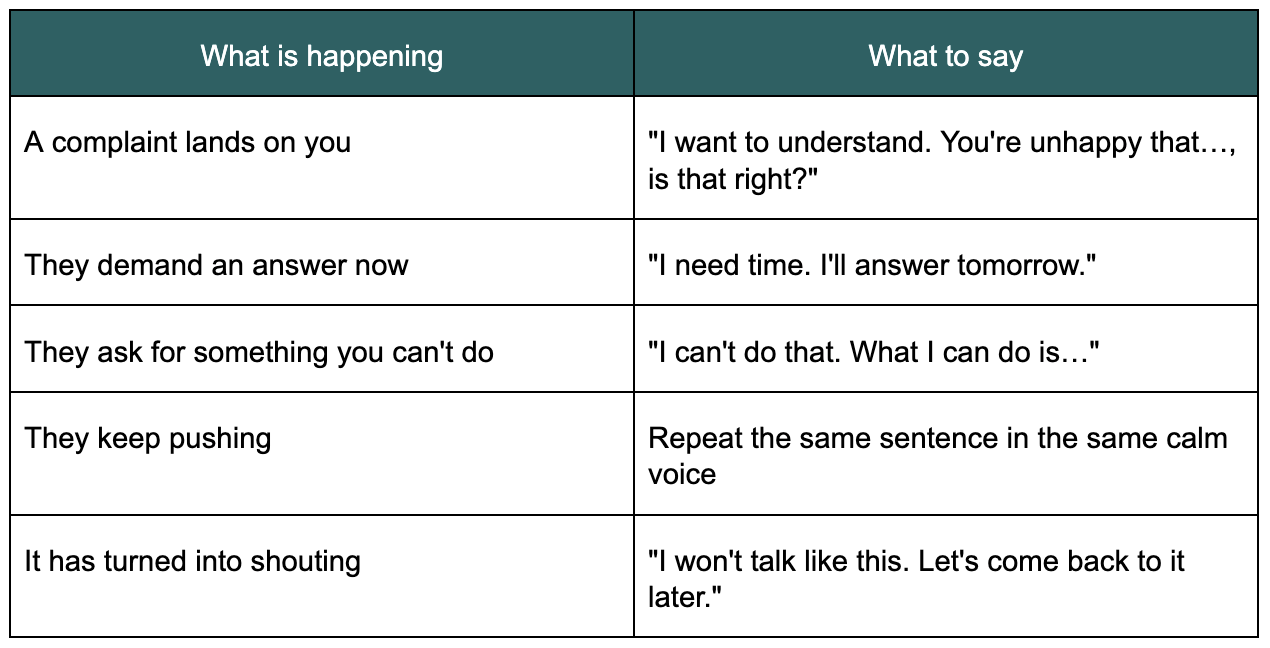
The first one works best. When people feel understood, they usually get quieter.
Repeating one sentence is not rude. You do not need to invent new explanations or justify yourself.
Sort the complaint into three piles
After the conversation, write down what they wanted from you and sort it:
- Mine. I really did get it wrong. I'll fix it.
- Partly mine. I'll do part, and we'll agree on the rest.
- Not mine. It is someone else's expectation, or their bad day.
Another person's anger is their feeling. It does not prove you are at fault.
If someone complains to you all the time
Listening to complaints is tiring too. Two simple steps:
- Ask: "Do you want advice, or do you want me to just listen?" Often they only need the second, and there is nothing for you to solve.
- Name a time: "I've got ten minutes, I'm listening." When it is up: "I have to go. I'm on your side."
You can care about someone without carrying their problem.
After the conflict
The body stays tense for a while. Help it:
- walk fast for five minutes;
- wash your face with cold water;
- write what happened in three lines, then close the note.
Try it right now
- Pick one sentence from the table. For example: "I need time. I'll answer tomorrow."
- Say it out loud three times. Calmly and slowly.
- Save it in your phone notes.
In a hard conversation, you only remember what you have already said out loud.
Important: you don't have to put up with everything
Arguments and complaints are a normal part of life. Insults, threats, humiliation and violence are not. That is not something to "cope with". Leave the conversation and ask for help. If you are in danger, call your local emergency number.
When to get help
Talk to a therapist or doctor if fear of conflict makes you agree to things that harm you, if you can't sleep or work for days after an argument, or if you feel bad nearly every day for more than two weeks. If you think life is not worth living, get help now: see the crisis page.
In RIVA PSY you can note what happened and how you felt, and calmly prepare for the next conversation. It stays on your phone. [Store link or "Notify me at launch" form]
Based on: interpersonal skills from DBT, Linehan's manual, 2015 (Guilford).